Most businesses that come to us don't have a budget objection. They have a clarity problem. They know their team is spending time on things that feel inefficient. But "feels inefficient" is not a business case.
The question they need to answer, the one that unlocks the budget decision, is: what is this actually costing me, in dollars, per year? This post gives you the formula. Three calculations. Fifteen minutes. You will know exactly what automation is worth to your specific business before spending anything.
The Three Cost Buckets
Manual work costs you money in three ways: the labor cost of the task itself, the error cost of mistakes that would not happen with automation, and the revenue cost of deals and leads you lose because manual processes are too slow. Most businesses only see Bucket 1. Buckets 2 and 3 are often 3-5x larger.
Bucket 1, Labor Cost Formula
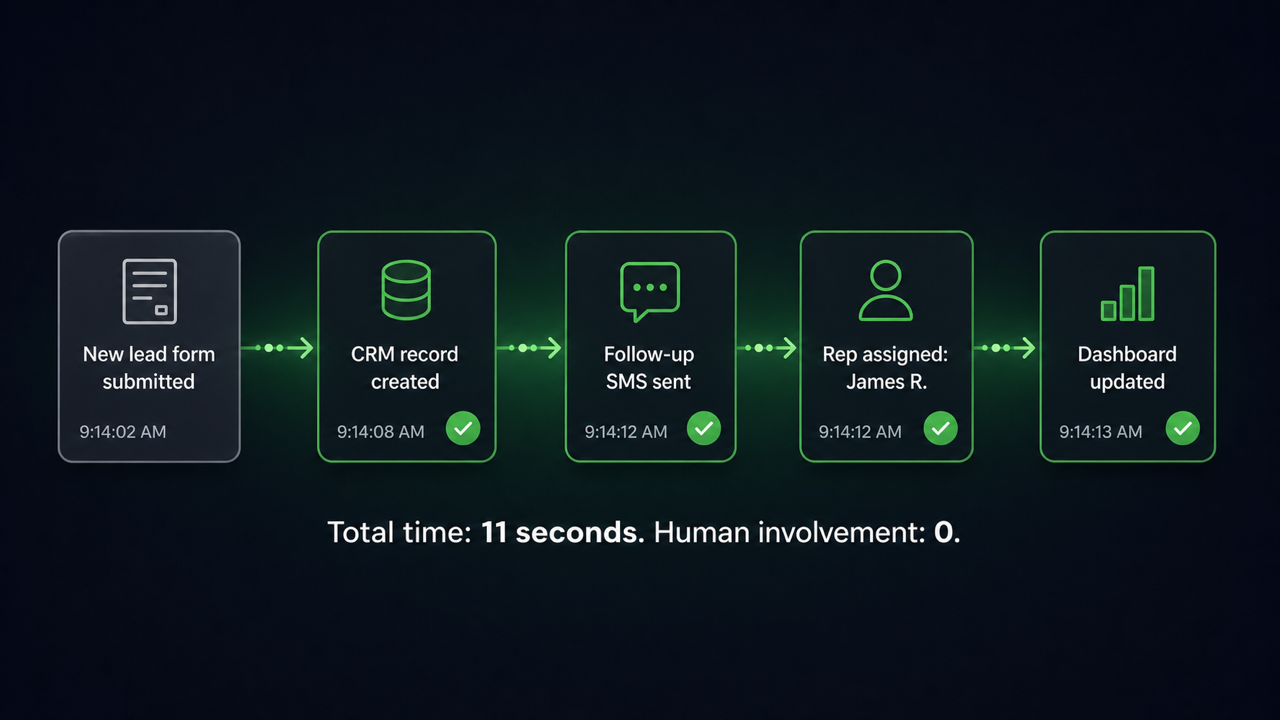
Annual labor cost = (minutes per task ÷ 60) × (times per week) × (hourly rate) × 52. Example: a sales coordinator spends 12 minutes entering each new lead. 12 ÷ 60 = 0.2 hours. 35 leads/week × 0.2 = 7 hours/week. At $22/hour: 7 × $22 × 52 = $8,008/year. To enter leads into a CRM that the form could populate automatically. Do this for every repetitive task, most businesses find $30,000-$80,000/year across 5-8 processes.
Bucket 2, Error Cost Formula
Annual error cost = (errors per month) × (average cost per error) × 12. Cost per error includes re-work time (minutes to fix × hourly rate), client impact (refund, discount, or churn), and missed-deadline penalties. Example: an agency manually sends weekly reports and one report a week has an error. Fixing takes 45 minutes ($18.75); 3 errors a year escalate into a contract conversation worth ~$1,500 each. Annual error cost: (1 × $18.75 × 52) + (3 × $1,500) = $5,475/year.
Once you run this math, the investment usually looks obvious.
We'll run the numbers with you on your specific workflow. 30 minutes, no obligation.
Bucket 3, Revenue Cost Formula
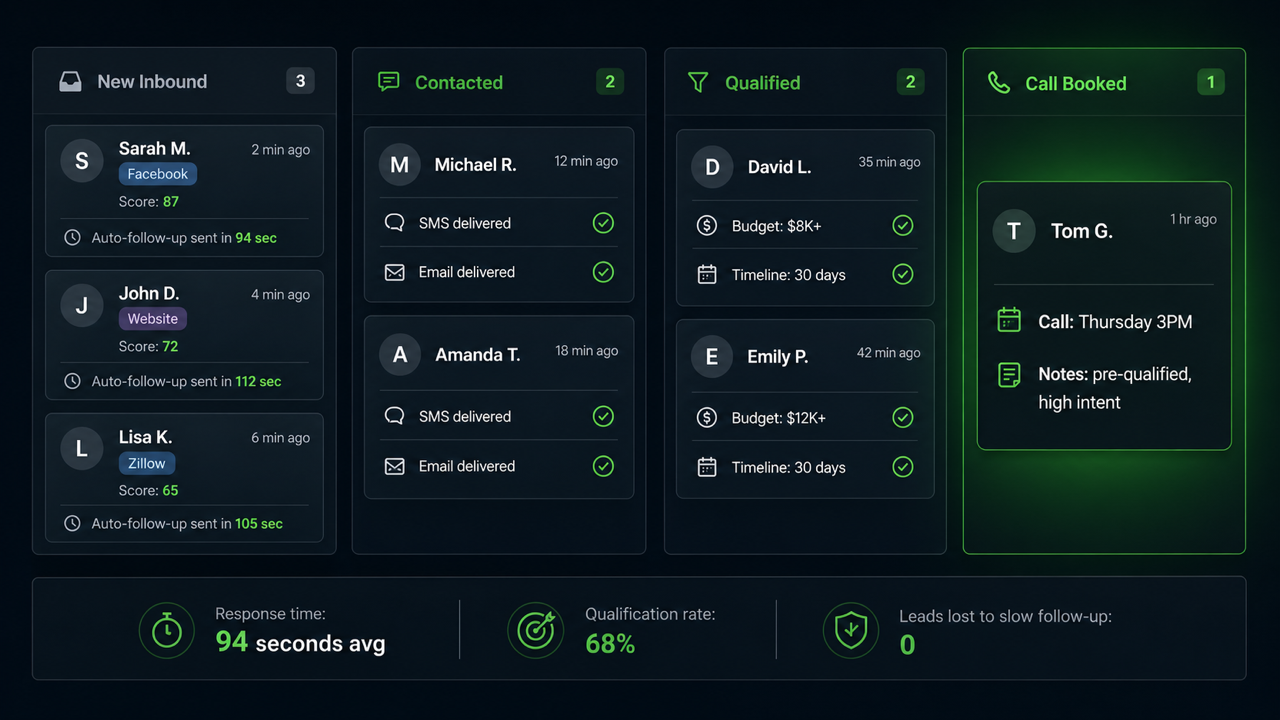
This is the biggest number for most businesses and the one they never calculate. Annual revenue cost = (leads lost or delayed per month due to manual process) × (average deal value) × 12. Example: a real estate team's average response time is 47 minutes. Industry data says 63% of leads that do not hear back in 5 minutes go to a competitor. 60 leads/month, 38 at risk, a 12% conversion gap = 4.6 more deals/month at a $9,000 average. That is $496,800/year. From one process.
Most businesses are too conservative when they run this. Use the industry research on response-time conversion, it is consistent across real estate, services, and B2B. Even using 10% of the estimate above, you are at $49,680/year.
Putting It Together, The Full ROI Calculation
Total annual value = Bucket 1 (labor saved) + Bucket 2 (errors prevented) + Bucket 3 (revenue recovered). Payback period = build cost ÷ (total annual value ÷ 52). Using the examples above conservatively: $8,008 + $5,475 + $49,680 = $63,163/year. Build cost: $2,500-$3,500. Payback: under 3 weeks.
A Realistic Range for Common Automation Projects
| What Gets Built | Typical Annual Value | Build Cost | Payback |
|---|---|---|---|
| Lead follow-up automation | $30,000, $120,000 | $1,000, $2,000 | 1-4 weeks |
| Client reporting automation | $8,000, $25,000 | $1,500, $2,500 | 4-10 weeks |
| AI chatbot (lead capture) | $20,000, $80,000 | $1,500, $3,000 | 3-8 weeks |
| Internal web app (replacing Sheets) | $15,000, $50,000 | $3,000, $8,000 | 4-16 weeks |
| AI voice agent (inbound) | $25,000, $100,000 | $1,500, $3,500 | 2-6 weeks |
A business owner who ran this calculation called us the next day.
He was a restaurant owner spending 22 hours a week on manual order coordination and missed-call follow-up. The math came to $87,000/year. The build cost was $2,800. He approved it on the call.
What to Do With This Number
Compare the annual value to the build cost (aim for the value to be at least 10x the cost). Compare to payback period (under 8 weeks is excellent, under 16 is still very good). Start with the highest value × shortest build time. If the number is not big enough to justify a custom build, sometimes a $300 Zapier setup is the right answer, and we will tell you that.
You don't need to commit to a $50,000 digital transformation. You need to find the one process where the math is obvious and start there. Most businesses find it in the first 15 minutes of this exercise. It is usually something they already knew was inefficient, they just didn't know the dollar amount sitting inside it. Now you do.
Part of a bigger guide